



BMW key replacement Reading: plan an all-keys-lost enquiry around the immobile vehicle
When no usable BMW key remains, the enquiry must describe both the security problem and the car's actual condition. The existing Reading page includes lost-key and spare-key requests alongside mobile service. This guide concentrates on planning the former without presuming the car can be moved, the parking location is suitable or a security generation establishes compatibility. A useful request states whether any key survives, who can authorise work and what access or power limitations are already known. It separates those practical facts from the eventual technical recommendation.
Be precise about no usable key remaining
For a Reading BMW enquiry, explain whether every key is absent or whether one remains physically present but cannot start the car. Mention any remote-only operation and any key held by another driver. This avoids preparing for a straightforward spare when the real task concerns a vehicle with no established starting credential.
An all-keys-lost enquiry differs from adding a spare while a working key remains available. Say whether every key is missing, a key is visible inside, or another authorised person can bring a spare. If a key may have been stolen, distinguish that security concern from an accidental lockout. Ask what can be done about the missing credential and which functions any proposed action affects. Electronic authorisation and a physical emergency blade are separate considerations. Do not assume making a new key automatically prevents an old blade opening a mechanical lock, or that retrieving a locked-in key requires replacement programming.
Describe where the immobile BMW actually stands
Give the vehicle's current location rather than assuming it can be brought to your home or workplace. Explain barriers, available working space and parking permissions privately. If the vehicle cannot be approached safely, say so before an appointment is agreed; mobile service does not settle the suitability of every individual parking arrangement.
A postcode alone may not describe where work must happen. Supply the actual vehicle location, parking level where relevant, and whether there is safe space beside the required doors. Mention height barriers, controlled entrances, underground parking and any permission needed from the premises operator. Check that a visiting vehicle can enter and leave without blocking emergency access. Do not move a car into an unsafe position simply to make an appointment easier. If the vehicle cannot be approached safely, explain that limitation before authorising attendance. Access arrangements should be confirmed with the people controlling the site rather than inferred from a map.
Report the battery condition without trying repeated resets
A BMW that has stood while keys are missing may have electrical symptoms as well. Report dim displays, previous charging or any recent jump start without treating them as proof of lost key authorisation. Do not disconnect the battery merely to provoke a fresh result or assume a silent dashboard identifies the security fault.
Remote locking and electronic starting systems rely on a functioning vehicle electrical supply. Dim displays, irregular central locking or a recent flat battery are important observations to report, not proof that a key has lost its coding. Avoid disconnecting the battery or repeatedly attempting to start the car simply to reset a warning. Those actions can obscure the original symptoms and may create further difficulties. Tell the technician about recent charging, jump starting or battery replacement. Any power support needed during security work should be planned for the vehicle and the procedure, rather than improvised with unsuitable chargers or loose connections.
Need help with your car now?
A call-out fee applies; your quote confirms the full price.
Provide the vehicle identity through a private channel
The Reading source refers to several BMW security families. Use those as context for a suitability enquiry, not as a reason to select parts yourself. Supply the requested vehicle details and explain any uncertainty in the history. A visible model designation does not replace confirmation of the current electronic configuration and proposed replacement.
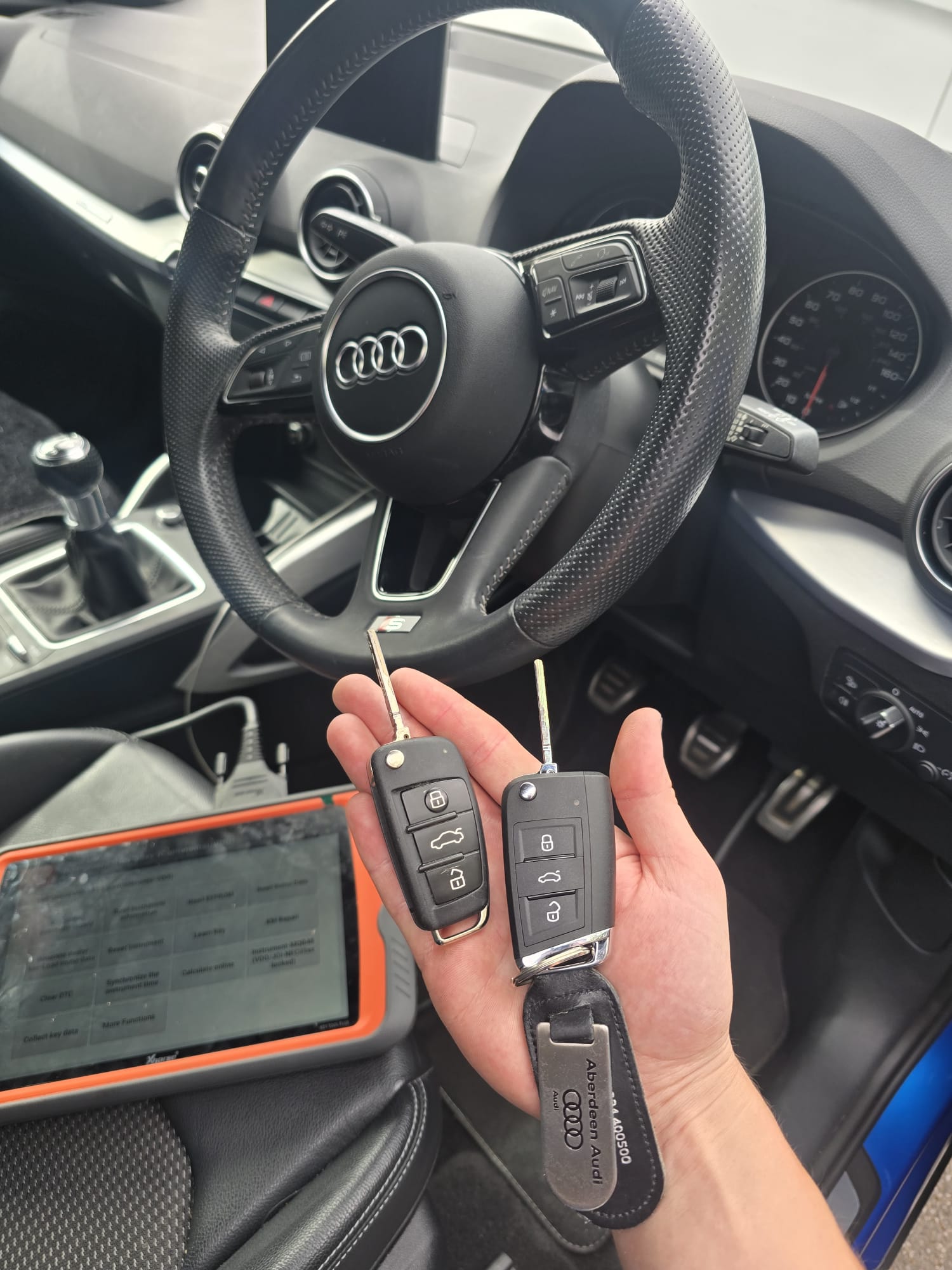
Similar-looking fobs are not reliable evidence of electronic compatibility. Provide the make, model, registration details and any relevant history of changed locks or security modules through a private channel. Ask for confirmation against the particular vehicle rather than a broad statement about a badge or model family. The year first registered may not settle every technical detail. Existing keys and diagnostic identification can provide additional evidence where needed. Do not buy an unverified online fob and assume programming will make it suitable. Establish what is being supplied, which functions it should provide and what limitations remain before agreeing to proceed.
Say whether the missing BMW key creates a security concern
Explain if the loss involved identifying information or circumstances suggesting theft. Ask about the missing credential separately from the replacement needed to use the car again. Do not presume that producing a working fob changes every electronic permission or prevents the original mechanical blade from operating a matching lock.
When a key disappears in circumstances suggesting theft, record that concern separately from the practical need to regain access. Follow any relevant police, insurer or vehicle-provider advice, and avoid publishing identifying details of the parked vehicle. Ask what security measures are available for the specific system and what they do not address. Removing an electronic credential, where possible, is not identical to changing a mechanical lock. Do not assume a replacement key resolves every consequence of a missing original. A clear security discussion helps the customer choose appropriate work without being reassured by a repair that only restores convenience or mobility.
Arrange an authorised person to remain involved
If another person will meet the technician at the Reading vehicle, agree their role in advance. They may need to provide access, answer history questions or receive the completed key, but those tasks do not automatically make them the approving customer. Establish the requested authority and handover arrangements privately before the visit.
Decide who will remain with the vehicle during assessment and who will receive the completed key. If the named customer must leave, establish an authorised handover arrangement rather than passing security items through an informal chain of people. Keep keys, identification and paperwork out of public view. Ask what records will be supplied and retain them with the vehicle's service information, not attached to the key itself. A receipt can document the agreed work, while the working key should be stored separately from any details that would make a future loss more difficult to manage or expose private security information.
Need help with your car now?
A call-out fee applies; your quote confirms the full price.
Confirm what restoration of use means
Ask for a distinction between opening the car, supplying an electronic credential and preparing mechanical access. If the door is already open but the engine does not recognise any available key, describe that clearly. The agreed result should match the actual missing functions rather than rely on a general promise of a replacement.
A car key can perform several independent tasks. Its blade may operate a mechanical lock, buttons may control the central locking, and an electronic credential may authorise starting. Success with one task does not establish that the others are healthy. Describe each result separately when requesting help. An unlocked door with a persistent immobiliser warning is different from a responsive remote with a jammed blade. Avoid assuming that a replacement battery, a newly cut blade or remote pairing will solve every symptom. The proposed work should identify which function has failed and what evidence supports that conclusion before parts are selected.
Verify the finished replacement before changing plans
After the agreed work, check the specified entry and starting functions before assuming the BMW is ready for ordinary use. Ask for any remaining warning to be explained rather than silently accepted as part of a lost-key job. Keep the new key secure and account for any old or damaged items returned with it.
Before putting a repaired or replacement key into everyday use, check the functions included in the agreed work. Locking buttons, unlocking buttons, boot access where fitted, mechanical blade operation and engine authorisation are distinct checks. Use the correct procedure for the vehicle rather than assuming every handle or button behaves identically. Ask for an explanation of any feature not included or not working as expected. Existing authorised keys should also be accounted for. A successful remote locking test alone is not evidence of a complete starting key, and a successful engine start does not prove every convenience function has been restored.